
TRAIN DREAMS: “Looking Over Your Shoulder” (For Loss)
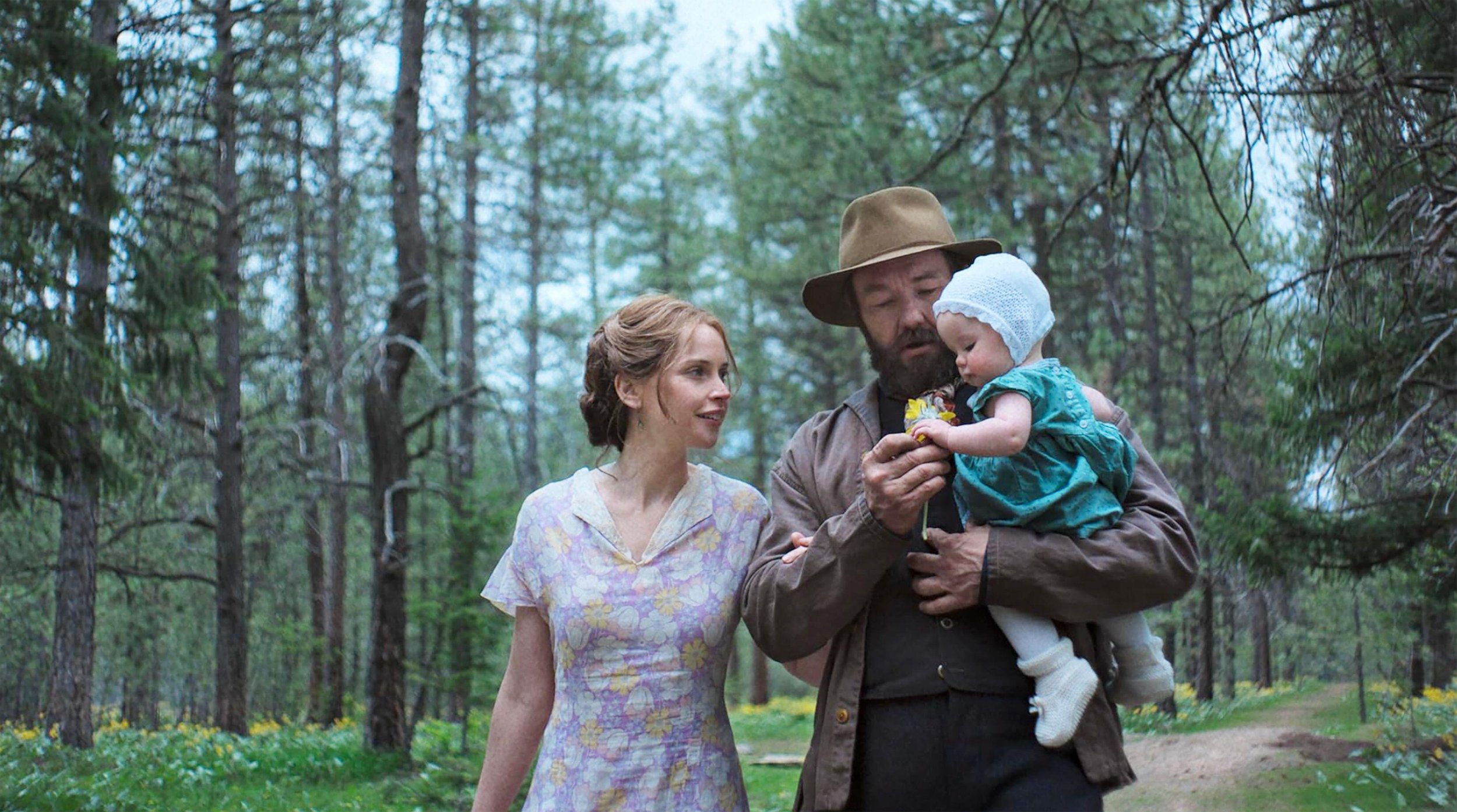
No one ever told Robert Grainier what happened to his original parents in Train Dreams. But when you’re a 6-year-old alone on a train to somewhere unknown, that’s trauma. You spend your life looking over your shoulder, as if something horrible is about to happen. Because it already did.
Trauma of Early Loss
Robert Grainier (Joel Edgerton) lost his parents. That we know. The fact that he doesn’t know what happened to them could mean a few things. They were gone before he was old enough for memory. Or something so traumatic happened that he blocked the memory from his mind. That’s called dissociation. Did they die or disappear violently? We’ll never be sure, nor will Robert. But we do know that he’s horrified by violence, baffled by the casualness of it. Like the mass deportation of the Chinese families from his town. And by the cruel and off-handed way a young Chinese fellow-laborer, Fu Sheng (Alfred Hsing), was accused and flung off a bridge. “What did he do? What did he do?” Another random act of violence, as a confused and horrified Robert sat helplessly watching. Robert’s helplessness suggests what he felt as a child when his parents were just as suddenly gone. When that happens, a child is left with guilt, no matter how irrational, feeling he should have done something to save them ... as if he could. When you lose everything as a child, you know horrible things can happen. So, you’re always looking over your shoulder, expecting the next catastrophe, expecting any good thing to be taken away from you.
“Looking Over Your Shoulder”
We first hear the phrase, “looking over my shoulder,” when a Black man strides onto one of the logging sites looking to set right the murder of his brother, “just because of the color of his skin.” The murderer, Sam Lubbin, it turns out, is a fellow logger, and the Black man shoots him, telling the other shocked loggers why. He says to them, “If any of you have a problem with what I’ve done, let’s get it settled right now. Because I don’t want to always be looking over my shoulder.” They sit stunned. Quiet. “Very good, then,” the man sighs. A big sigh. “Sorry to have interrupted.”
Looking over your shoulder is what you do when you expect something bad to happen. Call it catastrophic thinking. Waiting for another disaster. Or for the other shoe to drop. You never feel safe anywhere. Especially when you’ve already lost everything once. Or when you’re terrified of the repercussions of the anger you feel, even if (unlike the Black man) you never express it at all.
Robert Grainier never gets angry. He’s as patient and quiet as can be. But, with all he’s witnessed, with all the losses from nature’s tragedies, downed trees killing his friends, or a fire taking the ones he loves and needs the most, you can bet that anger is a part of his terrible, terrible grief. Especially when love was unexpected in the first place. And when Gladys (Felicity Jones) and his little daughter Katie (Olive Steverding) are more precious to him than the whole wide world.
Unexpected Love
Robert dropped out of college as a young man. He just wasn’t interested in anything. You might say, he’d given up. Quiet despair isn’t uncommon when everything that meant anything disappeared when you were small. How can you let yourself want or hope? Robert didn’t. He existed in his quiet, tentative way. Moving through the world without leaving much of a mark.
That is, until he met Gladys. But it wasn’t Robert who met Gladys. He was only at church because his cousin’s wife told him to come. He wasn’t a believing man. How could he be? With people suddenly gone? He kept his eyes cast down. Didn’t notice Gladys. But. She noticed him and introduced herself. No, Gladys wasn’t afraid to want something. And, if it wasn’t for her, Robert would have passed her by. Lucky, he didn’t. He needed love as much as the next person.
No. Robert didn’t expect love. And he got even more than he bargained for. He got someone who said his name in the most special of ways. Someone, always happy to see him. Someone who waited and didn’t leave. Someone who gave him a child. Katie. Making the family he’d never had.
Yet, when you suddenly have so much, on top of early loss, fear follows you around like a ghost.
Fear & Longing
Fear followed Robert every time he left his home, the only place he ever wanted to be. But, he had to leave for logging and railroad work to make a decent living. There were no well-paying jobs close to home. And the jobs that he had, well, they were far away. And, dangerous. Very dangerous. He saw many a man die. To his horror. Fu Sheng tossed off a bridge. A man was shot to death in revenge for killing a man’s brother. Trees felled, but falling the wrong way. Those killed too many of his comrades. Arn Peeples (William H. Macy) was one. Arn, he got really close to, as close as Robert let himself get to people. So, Arn was a major loss. Another loss he couldn’t control. Did he tell himself to be careful? You betcha. But still. He felt death was following him.
Robert longed for Gladys and Katie, happiest when with them and in Gladys’s safe arms. It was ok to long for them if he came home, and there they were, waiting, glad for the time they had. Of course, Gladys didn’t like him gone. Once, they almost fought. But Robert didn’t engage in anger. He was a rational man. He had to make money. But for a while, his longing got the best of him, too. And, he got odd jobs around town. Until they couldn’t make ends meet again, and he had to go. But that time, he was scared. You might say he had a premonition. And, well, when he came home, a fire was blazing in the wooded area surrounding their home. He tried to get to them, Gladys and Katie. He tried as hard as he could. But the fire raged. It burned up everything he had.
When The Worst Happens
When the worst happens. Again. You can’t wrap your mind around it. Now, grief tries to catch Robert. It’s too much to feel. Especially when you’ve been haunted by the fear of something horrible just around the corner. But. It can’t be real. Robert goes into hermit mode. Still. Waiting.
Waiting for them to come home. As tenaciously as he’d believed horror would catch up with him.
Yes, Robert looked over his shoulder and saw death following him. And he couldn’t save the ones he loved the most. Couldn’t save himself from the trauma of another loss. His family. Gone. Again.
As trauma works, Robert won’t let himself believe it. It can’t be true. Can it? Gladys and Katie are somewhere. Trying to reach him. Trying to come home. They have to be. AND. SO. Robert waits. But as he waits, he’s tormented by guilt. By the ghost of Fu Sheng. Who he, too, didn’t save.
Is It My Fault?
There are many ways to blame yourself. Even when it’s not your fault. But children. Somehow. Always believe that they must have done something to make the worst happen. And that they should have done something to stop it. To save the ones they need. The ones they lost. Blaming themselves. Just as Robert blames himself. Earlier too. For not stepping in. When his comrades were threatened with violence that made no sense. Any more than it had when he was a child.
But why didn’t he do something? Why did he just sit there? Robert blames himself. For so many things. But now, he has reasons. Why wasn’t he home where he should have been? Why did he abandon his wife and child, as he’d been abandoned? And, why did he feel so helpless...?
Because he was helpless. Children are helpless. When you know you had no power to stop death as a child, you don’t believe you have any power now. Against forces that take control. And, those forces might be violent men. Or the violence of nature. Of a blazing, out-of-control fire.
Yet, despite blaming himself – or maybe because of it – Robert Granier will not let hope die. Maybe he’d lost hope as a child. As a young man. But. Now. Hope will wash away his guilt.
When Hope Doesn’t Die
Hope may not die. But you can wither up, waiting. Hermit-mode makes you numb. It’s a trauma response. Waiting gives you hope. But it doesn’t save you from the loneliness of now. The loneliness that is the huge gaping hole in your heart. And, when you can’t do anything with the regrets for what you didn’t do ... being home to save them ... or go with them. Then. You wait. And hope. And. You don’t let hope die. You can’t. Because if hope dies. Then. They are GONE.
So, Robert waits. And people wonder. They even talk. Many don’t understand. They think he’s strange. The hermit. Maybe it’s hard for most to fathom the depth of his grief. Piled on top of his first trauma. The loss of his original family. Happening again. Like it is. So, he knows. Robert knows they are looking for him. Trying to find their way back. And Robert doesn’t eat. He waits. He goes hungry waiting. As hungry as he is for the love he’s lost. For Gladys and Katie to come back.
One old friend. A real friend. Has empathy. And when you’ve lost so much, a second time, empathy is what you need. Because if you can’t have those that you need the most. Then empathy is second to none. That’s Ignatias Jack (Nathanial Arcand). His quiet presence matches Robert’s. Challenges absence. Offers food. Support. Kindness. Steady knowing. When no one else does.
Flashbacks & Memories
There’s a difference, you know, between flashbacks and memories. They get confused for a while, for Robert. Memories bring mental pictures of his happiest times, but torment him with what he doesn’t have. They morph into flashbacks, imaginings of how the fire took Gladys and Katie. Drove them away. Consumed them. Which is what Robert cannot accept. He sees them in his mind’s eye. Memorializing the times that they had. Longing for them. Grief-stricken. Tortured by his helplessness to stop the loss. To bring them back. He wills them back. Waits. Years. He waits.
And then, “Katie,” a starving and sick wolf-child, shows up on his front porch. Is it delirium? An overabundance of hope? A fantasy he’s longed for? Or reality? Robert puts her to bed, nurses her, gratefully loves her (long after he pictured her, a toddler, watching her mother die.) This is what he’s waited for. The return of his loved ones. Katie here. But. Then. Just as suddenly. Katie is gone.
Was she a phantom of his making? Did she run away, not remembering him? Scared of people, being alone for so long? Then again. Was she unable to accept love, not remembering what it is?
Can Robert accept love? Can he let people in after so much loss? Is it safe to want anything at all?
Understanding & Acceptance
Accepting such traumatic losses is nearly impossible. What Robert needs is a lot of help and support. But he has to let people in. Let them reach him. To make him know he’s not alone.
That begins with Ignatias Jack. Ignatias Jack is persistent. Keeps coming back. He knows suffering. Robert takes the food Ignatias Jack offers. The company. The gentle care. Robert starts to thrive. His guilt, the presence of Fu Sheng (a non-accusing phantom) fades. Robert returns to the living.
But it is an unexpected someone, a woman who also lives with recent loss, who brings acceptance. Her name is Claire Thompson (Kerry Condon). A nurse. A forestry worker. She’s accepted the loss of her husband, moved on from her grief, and found meaning again in the natural world. She helps Robert trust in life in a way he never has. Helps him have faith in resilience. To live with his memories as treasures, nurturing him (not tormenting). Holding Gladys and Katie’s love close.
When Robert dies, he dies peacefully. An old man now.
His fears and grief have let him go.