
NO OTHER CHOICE: When Desperation Drives You Crazy
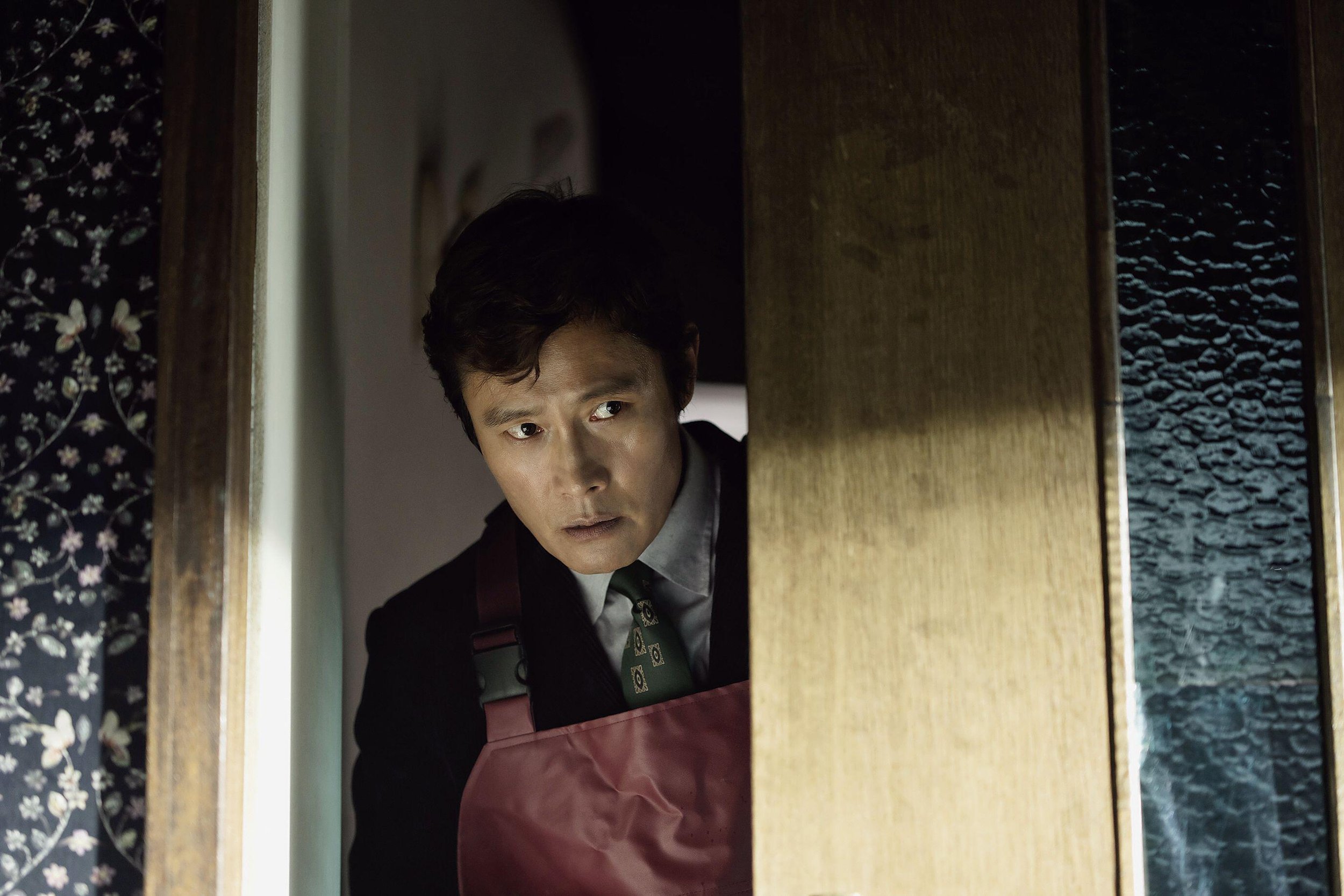
Extreme desperation and humiliation can drive you crazy. Totally out of your mind. Witness Man-su in No Other Choice. There are other choices ... but since he isn’t in his right mind and has lost any sense of his old human values (he was a labor organizer, after all), he doesn’t think there is. Desperation to get rid of his competitors makes him believe he has only ONE choice: Murder.
That seems uncharacteristic of a moral man like Man-su (was). But then, again, he was already losing it when he ran over a dog and didn’t even show one ounce of feeling. You can’t afford to feel anything for others when you lose the job that defines you as a successful man (a job you even won awards for). And when your family relies on you to take care of them. Plus, what if you might lose the childhood home you bought with the money you earned? The home that carries all your history and memories? These are prime grounds for desperation. And when more is piled on top, let’s say, 13 months doing menial work and then being humiliated at a job interview by a man who used to be a rung below you? Well, that’s more than enough for Man-su (Lee Byun-hun) to lose his hold on reality. And, then, to end up being totally consumed with only himself.
No One Else Matters
Trauma can make you turn in on yourself. Live in an isolated, insulated, self-preoccupied world. Terrified of what will come next (it can’t be good.) When you’re desperate, no one else exists. You can’t imagine anyone cares about you either. That’s Man-su’s predicament. He’s been thrown away, outdated, not needed, in this increasingly automated world. He doesn’t matter. He thought he did. He even got awards for his work. Man-su’s confidence has crashed. It’s lower than low.
Success. That’s his manhood. That’s what gives Man-su self-worth. That’s what makes him feel attractive to his wife, Mi-ri (Son Ye-jin). Their’s has always been a true love story. Dancing together. Being close. He can’t let himself down. Or Mi-ri. Or their kids, Si-one (Woo Seung Kim) and Ri-one (So Yul Choi). Ri-one already has social insecurities. The loss of their dogs (to stay at Mi-ri’s parents) because they can’t afford to feed them, and the accident that killed a dog, have set her back a great deal. She can’t even enjoy the cello, her sole pastime and obsession (she’s a child prodigy). And, Si-one, well, he’s a teenager, at a vulnerable age, confused and desperate too.
So, how can anything matter except for saving face (to himself and his family)? Man-su’s got to regain his footing, get back to a prosperous position. He has to. And, right now, to make matters worse, there are no jobs around. Not of the caliber Man-su needs. Anyone and everyone else is in his way. And, when he’s humiliated at a rival paper company, Paper Moon, by line manager Choi Seon-chul (Park Hee-soon), who was his subordinate, he goes over the edge. Humiliation drives him crazy. It reinforces what he feels about himself. There’s No Other Choice.
Killing the Pain (of “Less Than”)
Crazy with pain. That’s what Man-su is. And, his pain is the pain of a man with a terrible blow to his self-esteem. Crushed. That’s the best word for it. How could he go from an award-winning employee at Solar Paper? From a man who bought his family home, supported his beautiful wife and children in style? To this? To a man with no job at all. Home threatened. He can’t accept that.
The only thing that will take care of how low Man-su feels is winning the job at Papyrus Paper. BUT. And, it’s a very big BUT. Man-su has competitors who are more qualified than he. (He knows this because he put out an ad himself.) Another blow to his already very fragile self-confidence. If they’re more qualified, he doesn’t have a chance. That’s unbearable. It’ll kill him to lose again.
He can’t keep feeling less than these other men. He knows, knows without a doubt, that the only way to take care of this problem (of feeling terrible about himself and no job prospects) is to kill them. He has to. There’s No Other Choice. There can be no more FAILURE. Man-su knows he’s the man for the job. And, he must be sure he gets it. A man with good morals up to now, Man-su’s conscience suddenly goes awry. That’s what desperation can do. Now, anything goes...
Going Crazy: Anything Goes
Man-su’s first attempt to eliminate his competitors (AKA enemies) is not premeditated. At first, when Choi Seon-chul treats him with contempt, Man-su responds out of rage. He grabs a potted plant to smash it over Choi Seon-chul’s head, but stops himself when the plant owner spots him. After all, Man-su is smart enough not to get caught (although how is a true miracle).
But humiliation makes him crazed. You see, he already has a voice in his head that’s treating him with scorn. “Failure.” It calls him. No. Man-su will prove this voice wrong. He most definitely will. His spontaneous act of anger gives him an idea. He knows there are competitors for the job he’s applying to. He must WIN. It’s a contest, to be sure. And, the only way to succeed is to be sure those competitors are gone. What better way to remove the threat than to kill them?
Man-su, usually a rational man, mistakes his crazed state of mind for a logical plan. I suppose it is, in the mind of a person gone crazy with pain, since death is permanent. They can’t show up. And, in this mixed-up thinking that’s not thinking, the real point is to eliminate his psychic pain. To kill the pain, so that it doesn’t show up again, either. No more feeling not good enough.
Man-su has no fear of being a murderer. It’ll save him. There’s No Other Choice.
Eliminating All Competitors
Now, Man-su gets crazy frantic. He’s focused frantic. He plans things out. After all, he’s an organized man underneath his desperation. He must eliminate all competitors. The job must be his. Competition comes out of fear. Bad feelings about himself. Feeling beaten down. Not good enough. From jealousy. Believing others are better, will be seen as better, and that he’ll lose out.
Man-su is fighting the humiliating voice in his head with every ounce of determination and will that he has in No Other Choice. He plans out the murders (cold-blooded executions) of Goo Beom-mo (Lee Sung-min), who needs the job as much as Man-su does. And, Ko Si-jo (Cha Seung-won), desperate too, is working at a shoe store to provide for his family. Then, there’s Choi Seon-chul, for good measure. His job was Man-su's target in the first place. And, he “deserves” to go, doesn’t he? Since he set off these murder plans when he inflicted such unnecessary humiliation.
Man-su’s (rather comedic) organization and planning serve him (he accomplishes his “goals”). Although, as No Other Choice evolves, there are near misses to getting caught. Man-su slips up many, many times. Lucky for him, so do some of the others who matter. Mostly, Goo Beom-mo’s wife, Lee A-rah (Yeom Hye-ran). She’s having an affair, frustrated with Beom-mo’s depression at being jobless, and she doesn’t want to be found out. So, she helps out and finishes him off herself.
Complicity out of fear, of being discovered, or of loss, greatly benefits Man-su. Also, lucky for him, Mi-ri doesn’t report him or leave after discovering Si-jo’s body buried under a tree in their backyard. After all, she was tempting fate by dancing with her handsome boss and making Man-su jealous. And, she’s just as “happy” as Man-su is when he’s hired to fill Seon-chul’s vacant role...
Did Man-su Really “Win?”
Did Man-su really “win”? That depends on what you define as “winning.” He got what he wanted. BUT. At what cost? It might seem like he got away scot-free with cold-blooded murders. And, in the end, he and his family appear to be happy, resuming life as it was before he lost his job.
BUT. And, again, it’s a big BUT. No one really gets away with murder. Because. If Man-su doesn’t live with any external consequences, there is no way he escapes from internal ones. So, I guess we could say, he has No Other Choice but to live with what he’s done. In some emotional way.
There are all kinds of ways that guilt eats away at you. It gets you even if you don’t know it. One way to avoid feeling guilty is to shut down any access to your feelings. That, Man-su has already done. You can’t kill another person if you feel anything. And, we’ve already seen that in Man-su’s desperation, he doesn’t care about anyone. Except what he needs for himself.
Feeling nothing (for people or about what he’s done) is a sign of trauma. He did feel for his co-workers before he lost his job to machines. And, you know what? The fact that he could perform his murderous acts with no feeling makes him something of a machine, too, doesn’t it?
In feeling nothing for anyone else, Man-su becomes a machine of his urges to “save himself.” He becomes the very system that phased out his human relevance at his job. And, Man-su’s new job? He’s subordinate to a machine. Feelingless. Alone. De-humanized.
What kind of win is that?