
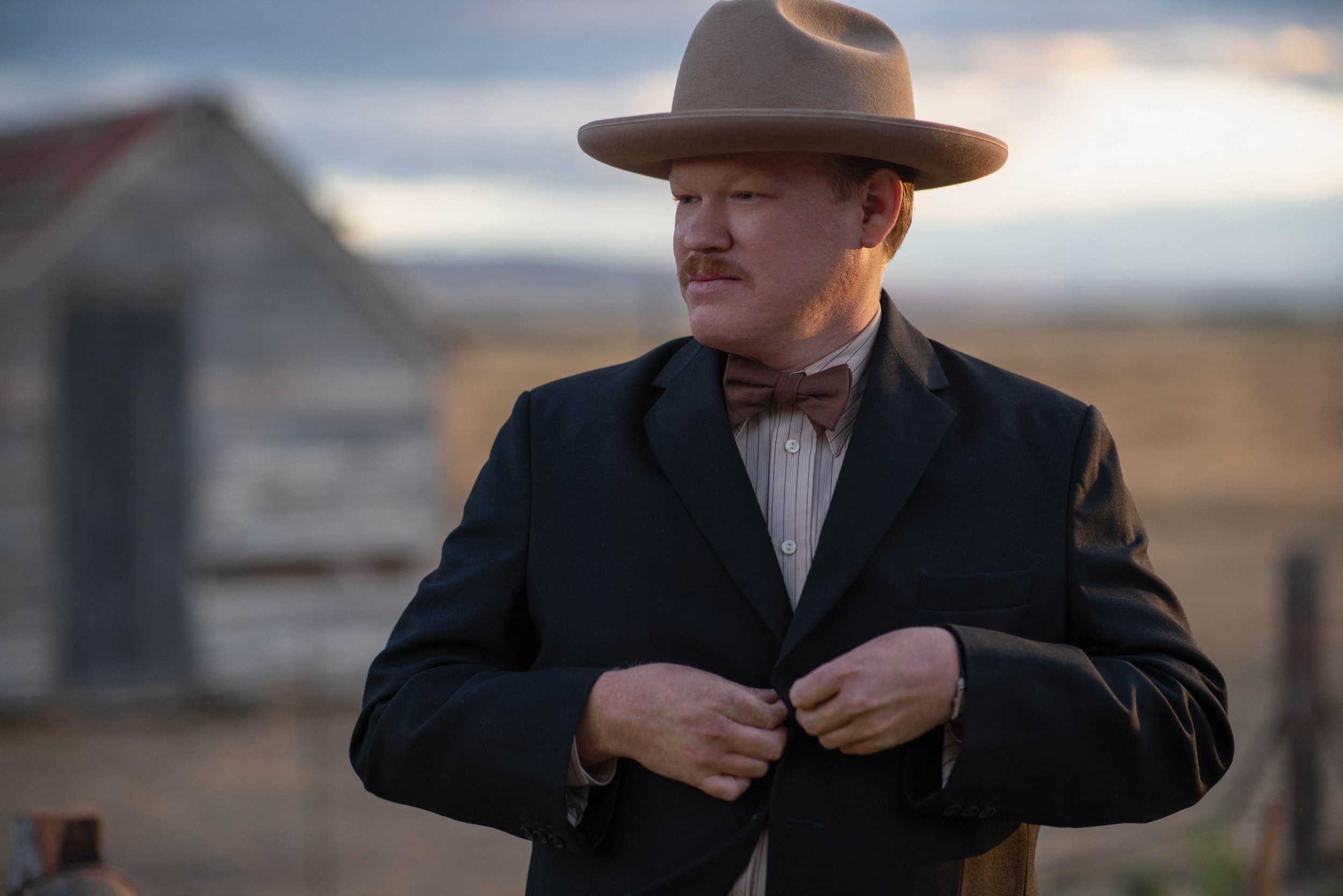
Jane Campion’s chilling film, The Power of the Dog, has much to say about the adage that what we hate in others is what we can’t accept in ourselves. And wow, does the character of Phil Burbank spell that axiom out in spades.
Sure, he embodies everything there is about toxic masculinity. Yet what is toxic masculinity if not self-hate? So, what’s Phil fighting against in the dark recesses of his conflicted mind?
And then we have Peter:
“For what kind of man would I be if I did not help my mother? If I did not save her?”
Peter’s (Kodi Smit-McPhee) words are the opening lines of The Power of the Dog. His mother, Rose Gordon (Kirsten Dunst), has been widowed for four years before the story begins in Montana in 1925. Yet Peter’s words only hint at what drives the film’s disturbing narrative about Rose, Peter, Phil (Benedict Cumberbatch), and Phil’s brother George (Jesse Plemons), as well as what catapults The Power of the Dog to its shocking end.
There’s much more to say about how each character handles very human vulnerabilities – mostly not well; because they don’t know any other way …
Spoiler Alert Ahead
We’re All Vulnerable, You Know
Many things can make us vulnerable. Loss is one. Shame is another. And Phil, Rose, and Peter – all three – have suffered both.
Phil lost “Bronco” Henry, his childhood mentor, who, as it later unfolds, was his first and undying love. Rose lost her husband to alcoholism and suicide. And Peter lost his father, whom he found hanging by a rope. Peter cut him down, this father who told him he wasn’t kind enough – just like Phil isn’t.
Yes, Phil and Peter? They have a lot in common, it turns out. More than meets the eye as The Power of the Dog begins.
Phil is laced tightly into his brutish masculinity as he torments a sensitive and effeminate Peter, who waits on the table where the rancher-cowboys dine, at his mother’s inn. Phil sets on fire one of the beautiful paper flowers that grace the table as a centerpiece; flowers Peter made to honor his mother’s old life as a florist. Such artistry is too soft and gentle for the likes of tough Phil.
And so Phil calls Peter “Miss Nancy,” encouraging his cowhands to join him in his humiliations. And they do. They are his pawns, his hands at deflecting his self-hate so that no one knows what he knows about himself: he is Peter (and Peter is Phil).
Peter is Phil, in ways that Phil misjudges and doesn’t anticipate. Peter can match his cruelty. Yet he’s better and more subtle at it than Phil; more studied and smarter. As he sees the dog in the mountain on his own, it is a recollection of Phil needing “Bronco” Henry to show him.
There’s no question that Peter has more steely self-esteem and solid determination; whereas Phil’s self-hate and quiet longing “do him in” in the end.
Ravages of Hating Our Longings (On Others, Too)
We see the ravages of self-hate in Phil. He’s a prime example of what happens when shame takes the place of self-acceptance; how normal longings and inclinations to love (and a need for love) might cause shame.
Phil lived in 1925, after all – not the time for a gay man to reveal himself. Yet even now, many of us are equally burdened with shame for our longings. And if we’ve been traumatized as children, we might feel humiliated for wanting love in any form, thinking it’s a weakness; that we will be hurt.
So, what does Phil do? Phil gets rid of his self-hate (or thinks he does) by projecting his feelings of weakness onto Peter. And, earlier in life, by training himself to be a brutish cowboy – a man with a hardened crust so no one (he also thinks) knows who he really is.
That’s exactly what he later tries to train Peter (his alter ego) to become. But first, before he takes Peter on as his project, Peter is his target; his hated vulnerable, younger self.
Phil torments Peter with the complexities of his self-hate. He humiliates him and scares him by surrounding him with large horses and mean cowboys so he can’t get away until Phil decides to set him free. And later, when Peter discovers Phil masturbating alone in the woods with “Bronco” Henry’s scarf, Phil ragefully drives Peter away; wanting to erase what Peter now knows beyond a doubt.
Yes, Peter knows. He’s also discovered a stash of Bronco Henry’s old magazines of naked men scattered nearby.
And so Peter draws Phil in, seductively sharing a cigarette, asking him if he and “Bronco” Henry kept each other warm one cold night in the wilds – “naked.”
“Deliver My Darling from the Power of the Dog”
Yes, Phil does end up “befriending” Peter, but Peter senses, deep inside, he can’t trust what Phil is up to. Of course, Peter needs a friend, alone in the wilderness of his mother’s new life with her new husband, George. And also, in the wasteland of a now-unreachable mother, driven to alcoholism by Phil’s torment of her.
But Phil is no friend. Peter does know that.
Plus, we find, he’s more cunning than Phil. He has, above all, vowed to help and save Rose. And if he’s smarter and faster and quicker of wits than Phil can be, he knows he’ll find a way. And he does.
You see, Phil is making a rope for Peter – a rope by which Phil will ultimately, as well as figuratively, “hang himself.”
Because Rose, in her vengefulness, gives away the hides that Phil covets (or discards by his own selfish will), he’s run out of rawhide to finish the rope and panics. Peter offers to “help” him. He’s deviously saved some hide from an anthrax-infected dead animal.
An aspiring surgeon, Peter is interested in dissection. He is also well aware of the dangers of anthrax, and how that poison might seep its way inside Phil’s open wound. That wound is both the actual cut on his hand and Phil’s hunger for love.
So, Peter gets his revenge. Phil dies and no one knows that Peter is the cause. He frees Rose and, perhaps, himself – if guilt for murder doesn’t get the best of him.
Phil’s funeral over, Peter opens a Book of Common Prayer to the burial rite, reading a portion of Psalm 22:20:
“Deliver my soul from the sword; my darling from the power of the dog.”
Who Is “My Darling” & Who Will Be “The Dog”?
In ancient times, dogs were known as lowly pack scavengers who attacked the vulnerable. And vulnerability is what Phil and Peter both struggle against.
Yes, there’s vulnerability. Then there’s “the dog” – a vicious dog, not one known as man’s best friend. Unless, that is, you consider that this dog, in The Power of the Dog, is the ruthless guardian of all varieties of self-protection against being hurt by love.
And so it is, at the heart of Phil and Peter’s match: Who will be the dog? If nothing else (and there’s a lot “else”), it’s a one-of-a-kind race to the finish line.
Yet, maybe even more importantly, who is “my darling”?
“My darling,” to be sure, is a term of endearment for a loved one. Biblically, “my darling” is interpreted as one’s own life or soul. But with Peter’s vow at the beginning of the film to take care of his mother, “my darling” might be Rose, whom he defends with all his might from being attacked by Phil.
“My darling,” though, is much more complicated in The Power of the Dog, which explores the complexities of love: love of brother to brother (Phil’s abusive, hidden, love for George). He calls George “Fatso,” trying to look like he couldn’t care less at all because, in reality, Phil hates how much he needs George and can’t live without him.
And in love’s jealousy – Phil’s jealousy, spawned by “betrayal” when George marries Rose – he torments Rose and hates her, because she openly expresses the need that Phil cannot.
How Not to Give In to Savagery’s Power
Love opens all of us up to vulnerability. And managing human vulnerability is, for many people, a very difficult thing.
Phil handles his with cruel, tough, and hardened pseudo-masculinity.
George with passive niceness and avoidance of conflict.
Rose is driven to alcohol abuse to manage her fear and shame.
And Peter? He keeps quiet, silently becoming more and more determined to remain untouched; with his anger and resentment growing fast into a plan to wreak his vengeance.
An eye for an eye – that’s the endnote of The Power of the Dog. Not the most palatable one, to be sure, but certainly understandable.
Yet there’s another way to look at Peter’s fury, if we think of Phil as being a tormentor in Peter’s mind. We all have them. When we feel vulnerable and hate ourselves for what we deem our weaknesses, then we are easy prey to a voice inside our minds, like Phil’s, that humiliates, taunts, and tries to make us feel “bad.”
That’s likely what put Peter over the edge. He had no help; a young boy who believed it was his job to protect and save his mother. Who was there for him?
And Phil, “Bronco” Henry’s “darling,” also tortures Peter, his vulnerable self. Might we even surmise that Phil wishes Peter to be his new darling, a desire that can only go wrong because of the humiliation he guards against and Peter’s need for revenge?
Being deeply hurt can surely lead to a desire for revenge, even to the act itself, especially when helpless torture is involved. Of course, murder isn’t the answer.
But finding a way to stand up to savagery, to protest against it, to take back your power against oppressors and violators – even the ones inside your mind – that’s the essential thing.