
MIDSOMMER: Numbing Feelings & Hunger for Family Blind Dani
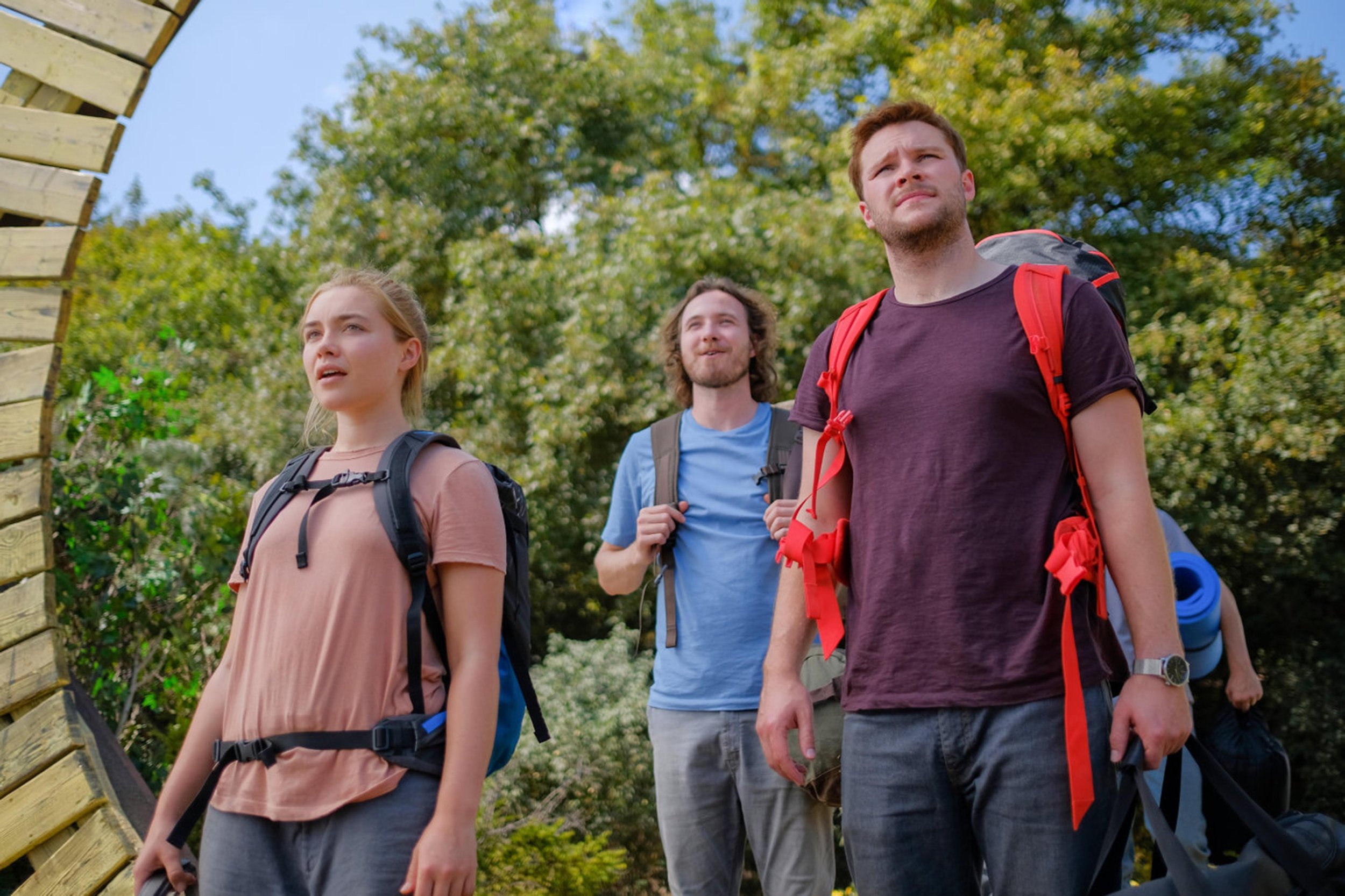
Dani suffers unimaginable trauma in Ari Aster’s Midsommar. The sudden murder/suicide of her parents and sister. Terrifying. Unstoppable. Unthinkable. She’s now an orphan. A trauma that brings such terrible grief, Dani can’t allow herself to feel it. Well, maybe she could if her unempathetic, self-centered boyfriend of four years, Christian, didn’t mirror the same numb detachment she uses to survive. She needs someone to hold the pain. But no one is there. This leaves her with confused hunger. Dani’s vulnerable. Starving. Open prey to being seduced into a place where she seems wanted, but not really for herself. AND. Where she lands is not healing.
Dani’s Trauma & Going Numb
“No, No, No,” Dani (Florence Pugh) screams. “No, No, No.” She can’t bear the loss. Can’t see it. Can’t know it. That’s common in trauma. You’re blindsided when trauma happens. Filled with feelings you don’t have any idea what to do with. You can’t be alone. You need someone there to help you hold the pain. Someone who hears you. Sees you. Understands what you’re going through. Dani tries. She turns to Christian (Jack Reynor), her boyfriend. Even before the worst has happened. When she suspects that something is very wrong. She needs him. He’s not there.
Christian is as detached and ambivalent as a boyfriend can get. He “guesses” he can come over. He hesitates before he says “I love you” back. He’s patronizing. Doesn’t take her seriously when she tells him she got a strange text from her sister, who’s not responding, and her parents aren’t answering either. He tells her she has nothing to worry about. Her sister is bipolar, and the more she responds, she gives her sister the attention she wants. He’s sure “it’s fine.” She’s not at all sure it’s fine, but she goes right along with him. He’s passing off her feelings as if they are nothing.
Dani blames herself for “leaning on Christian too much,” for needing “too much.” She feels responsible for his distance. That’s a sign of earlier trauma in Dani’s life, which makes her easily gaslit. Vulnerable to being controlled and to thinking that someone else’s way is the “right one.” Christian’s way is numb detachment. Saying that everything “is fine.” He’s never even cried.
Dani calls Christian again. It’s not “fine.”
We hear her crying, sobbing, “No, no, no, no, no, no ...”
We see firemen, paramedics. Breaking into a house. Following a line of gas from a car. Bodies are dead in a bed. Another body, dead with a gas mask on her face dead. Dani’s parents. Sister. Murder. Suicide. Dani continues to sob as Christian walks towards her house. Christian tries to hold her on her couch as she screams and sobs in distress. “Oh no, no, no, no, no, no, no, no, no, no, no...” This continues over and over. The grief is too much. Even if Christian were more capable of feeling, Dani can’t. She goes numb. She’s “in the world of Christian.” In Midsommar.
Seduction of Another (Far-Away) World
When you go numb after trauma, you go away from yourself. Your world, as you’ve known it, has shattered. You don’t want it anymore - that broken apart life and self; the reality of it all. So, you “leave.” In different ways. Sometimes you leave by detaching. Dani takes a break from school. Sometimes you’re seduced into a fantasy. That’s what happens to Dani when she goes to Sweden.
It’s a complicated thing. When the reality you live is too much, you want a different one. So Dani is drawn into the appeal of going to Sweden with Christian and his friends Mark (Will Poulter), Josh (William Jackson Harper), and Pelle (Vilhelm Blomgren), Christian’s fellow anthropology students. But Pelle isn’t the friend they think he is. He sees Dani’s need and vulnerability. He preys on it. Yes. It might look like he understands her. And that’s what he wants her to think. He’ll be useful to her. Give her something Christian doesn’t. The fact is, she’s more useful to him.
“So, you’re coming to Halsingland?” “Yeah, and we’ll actually be arriving on my birthday.” Her birthday. The first one without her family. That’s a trigger if anything is. Right now, though, she’s numb. “I hear you have a lot of festivities planned?” “Yeah, it’s a nine-day festival that my family is doing… special ceremonies and dressing up. It’ll probably seem silly, but it’s like theater.” Truly, it’s the farthest from theater anything can be. It’s a cruel and brutal reality below its seemingly lovely surface, like the reality she’s trying to escape. He shows her photos, white dresses, and flowers circling the head of last year’s May queen. Pelle looks at her, “I’m very, very glad you’re coming. I was so very sorry to hear about your loss. I lost my parents too, so I know.” Does he? Can anyone know the reality of her pain? Dani herself can’t. “0h, No, No....” She runs into the bathroom. She’s panicking and crying. Hard.
She has to get away from this terrible pain in Midsommar.
Once in Halsingland, Pelle suggests a drug trip on mushrooms. Dani isn’t ready, but she succumbs to the pressure. Ok, maybe a little mushroom tea? Maybe that will make her forget it’s her birthday. That she once had a family. That she witnessed the horror of them dead. But you can’t really forget. Not your trauma or your feelings. And, the word “family” keeps coming up. Everywhere Dani turns, she hears the word. “Family, family, family,” as Pelle introduces her to one after another, at “the beautiful (and seemingly) tranquil” Harga. There are always triggers.
A Baby Cries & Cries & No One Comes
No, you can’t really escape it. (Help getting through it is real. If you get the right kind.) But there’s no magic or tranquility at Harga. It isn’t what it seems. There, Dani faces one trigger after another. It’s her birthday. That’s a #1 trigger (for her devastating losses.) And, there are many, many more.
As soon as Dani, Christian, Mark, and Josh arrive, they are taken to a beautiful sleeping area with paintings, where the children stay until they are 36. “You’re a child until you’re 18, and that is Spring, and then at some point, we do our pilgrimage, which is between 18 and 36, and that is Summer, and then 36 to 54 is working age, and that’s Fall. From 54 to 72, you become a mentor.”
Dani asks, “What happens when you’re 72?” She’s soon to find out. There are many warnings that Harga is not a safe place. Another is the caged bear. Another is a baby, who cries and cries. Every night. The baby does not stop. That troubles Dani. It’s cruel.
It’s not holding. In Midsommar.
Pelle’s red-haired sister, Maja (Isabelle Grill), tells her with unfeeling matter-of-factness: “Her mother is on pilgrimage. It helps them to detach. Children here are raised by everyone.” There is no care for the baby’s pain. For her longing. A need for her mother. This Dani knows. All too well.
Preying on Dani’s Desperate Hunger
It makes sense, doesn’t it, that Dani’s hungry for love? She’s lost her entire family. That’s her trauma now. Yet, she’s likely always been starving. What was her childhood like? She had a troubled sister who demanded a lot. She says in a desperate message to her parents: “I’m always here.” Who was there for Dani? Who is here now? Certainly not Christian. The baby cries and cries. That baby lives in Dani, too. Longing for mother. Longing for love. Desolate. Empty. Hungry.
A woman with a grotesque, deformed, disfigured, swollen mouth flashes across the screen. We see that image more than once in Midsommar. It’s fleeting. You might not notice it. Like Dani tries not to know her hunger. For love. Empathy. To be held. She needs those things. Everyone does. Especially if you’ve been severely traumatized. And when love was never truly secure.
We see the mouth. There. Not there. Hunger is hidden in Dani because of her losses. Blocked. Wiped out. She’s confused. By all her feelings. Love. Loss. Need. The feelings she had for Christian. The cult at Harga sees this confusion and uses Dani’s hunger for their own. For their greed for power and control. Harga doesn’t help people find their own way. They draw them into theirs. Like Dani. They aren’t there for Dani.
In fact, their brutal practices are triggers for her trauma.
“Justified” Killing is Dani’s Biggest Trigger
The suicides. The murders. No feeling. As if it’s the “right thing” to happen. Just like Dani’s sister justified her own suicide and the murders of their parents. And, here it is again in Midsommar. This is supposed to be a ceremony? A willing sacrifice? “Let’s raise our glasses and let our nine-day feast begin.” They all stand at the table before their food. An older man and woman (these are clearly the 72-year-olds) come out of the yellow temple in light blue and are seated in blue throne-like chairs. Then, the rest sit. After they all eat, others in blue raise the thrones of the two elders and carry them away. Harga members stand looking upwards, worshipping. The man and woman are carried to the top of a big rock, with some smaller stones that look like tombstones.
The woman’s hand is cut with a knife. She smears her blood on one of the stones, raising her hands to the sky. Suddenly, she flies off the rock and lands on the ground on her stomach, bleeding. Dani screams. Hyperventilating. Simon is saying, “Oh my God.” Ingemar (Hampus Hallberg) says, “It’s fine.” “What the fuck? She jumped. She fell, she’s dead. How can you say it’s fine? Is this part of the ceremony? What the fuck?” The man now comes out on top of the rock. Simon screams again, “He’s doing the same fucking thing. Why is everyone just standing there? What the fuck, sir? Stop! Stop!” He, too, intentionally falls. But he’s still alive, choking. A man in white with a long hammer pallet goes over to the man, not dead yet, and hits him on the head. A woman does the same thing, smashing and bloodying his face, as if this is normal.
Dani’s eyes stare. She’s triggered. Completely re-traumatized. She runs away in tears. Gasping, she falls to her knees. Later, she takes a sleeping pill, but, in a nightmare, Dani screams as black smoke comes out of her mouth. We see flashes of her parents and sister, dead from carbon monoxide. Of the man’s face being smashed, reconstituted, and smashed again. The baby is crying. The ashes of the two suicides are removed. There is chanting. The baby cries for her missing mother, mirroring the cries inside Dani that she can’t let herself feel. A woman says these two have reached the end of their Harga life cycle. And, it is an honor to give their lives in sacrifice.
Yet, how can cruelty be justified?
And if anyone does, can you trust them if they say they “care”?
A Hypnotic Spell Isn’t Real Empathy
Harga seems warm and welcoming. Most cults are. Seductive and enticing. Drawing you in. Hypnotic flutes play. Women, men, and children dance happily in white. Father Odd (Mats Blomgren), a white-haired man, first embraces Pelle and then embraces Dani, saying, “Welcome home. We are so happy to have you.” If this doesn’t appeal to a recently orphaned woman, what would? Pelle draws a picture for her birthday – “it’s just something I do.” Christian forgot. These are parts of the spell a cult like Harga weaves. So that you’ll ignore everything and anything else...
Pelle “identifies with” Dani. He lost his parents, too. He tells her he never had the chance to feel lost because he always felt held. “By a family. A real family. That’s what everyone deserves, and you deserve.” He takes her hand. She says that Christian could walk in." “He’s what I’m talking about. He’s my good friend, but Dani ... does he feel like home to you?” Welcome home ...
“Home” is enticing. She’s just lost hers. And Dani’s drawn into the May Queen ritual: “We will dance until we can’t dance anymore, and she who survives last will be crowned for her stamina.”
But it isn’t stamina for Dani. It’s mania. It’s going so fast and so hard and so long that all her feelings are dead. “Don’t remember the home you lost. Don’t think. Don’t feel.” Spinning around the Maypole, Dani’s the last one dancing after the others fall. Crowned May Queen, she’s hugged by Father Odd. They all “adore her.” Dani’s surrounded by “love.” BUT. Is it? She cries out, confused and searching, “Mom? Mom?!” The one she really needs. The baby cries and cries.
But, no. Dani can’t let herself feel. Dani can’t grieve in Midsommar.
They sit at the table. Dani is now at the head. They toast her, “To the May Queen. To our May queen. You are family now, right? We’re sisters...” No.
Family can’t just be replaced or erased.
And, when Christian is spirited away, in a trance, to be used for the cult’s purposes (Maya has chosen him to impregnate her), Dani is now theirs. Betrayed, she yanks off her flower crown, gasps, gags, sobs, retches, and wails. He's given Dani no love.
But his betrayal triggers Dani’s grief.
The young women in her Queen’s court catch her as she sobs and retches and wails. They take her to her bed and shush her. Shushing is what she’s been trying to do with her feelings, the “No, no, no, no, no’s.” Refusing reality, refusing to know her grief.
She’s prime fodder for the cult.
The women groan and breathe in unison with Dani. They wail in unison. Louder and louder. The frame captures the distorted-looking woman with white blonde hair and disfigured lips. This merger doesn’t feed Dani’s hunger. This is not family. No. Their “mirroring” isn’t real empathy. Or holding. If the Harga cult had real empathy, they wouldn’t leave a baby crying. That baby is Dani, too. BUT. There’s no comfort for the baby. There’s no healing for Dani’s loss and pain.
Midsommar’s Cult Doesn’t Heal Dani
A cult demands sacrifice. Of individuality. Of who you are. You can’t have feelings that are yours alone. So. There’s no seeing you - no knowing your pain. And. So.
There is no real holding.
This nine-day ritual requires nine human sacrifices. All the Americans, except Dani, were brought here by Pelle for this very purpose. And, Dani, as the May Queen, must choose the last one to sacrifice. She chooses Christian, who betrayed her, who silenced his feelings long ago. And hers. Now continued by the cult. BUT. Killing Christian doesn’t release Dani from this numbness.
Numbness has been her survival. Sure, Dani has a big smile on her face, but that smile isn’t freedom. Dani is in a trance. The trance of losing herself.
The final nail in Dani’s coffin of deadness.
Plus, her “new family” justifies killing any human feeling in her. Harga says, coldly and matter-of-factly, “It’s fine.” BUT. There is no healing here. No holding Dani’s pain.
Healing isn’t merger. Escape. Or. Denial. You can’t replace what you lost. BUT. You can find empathy. You can find real safety. You can grieve. That’s healing. Especially if an empathic “someone” helps you hold your feelings.