
NO COUNTRY FOR OLD MEN: What’s Chigurh Trying to Kill?
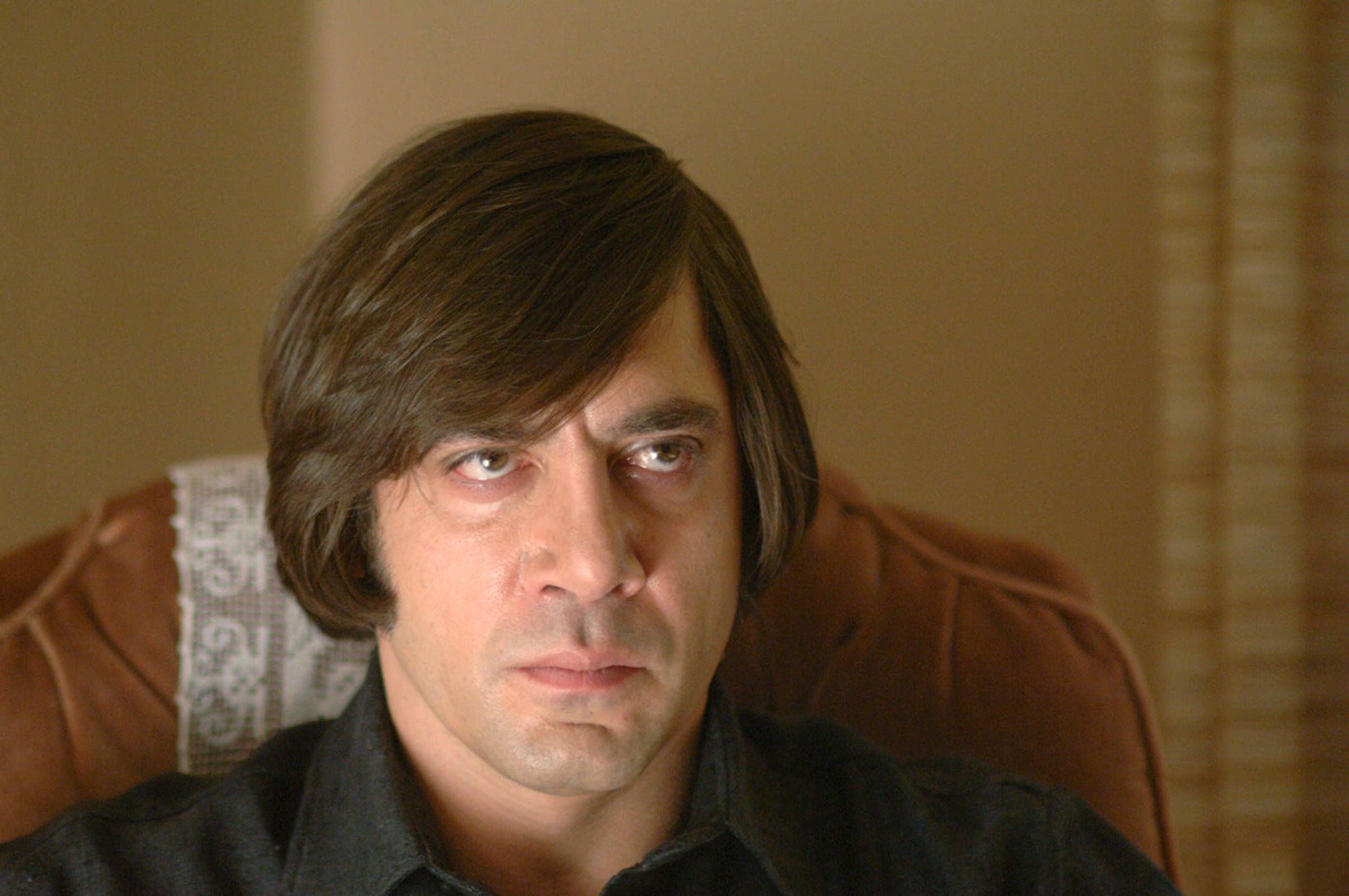
Anton Chigurh trespasses through streets and towns and into other people’s houses. A ghost. With a blank, feelingless face. Numb to the core. A man who kills without a second thought in Joel and Ethan Coen’s No Country for Old Men. Life means nothing to him. Not his own. Not anyone else’s. Is he a psychopath, as many people think? Maybe. But what does that label mean? The question is what makes Chigurh do what he does? What is Anton Chigurh really trying to kill?
Killing Hunger (& Feelings)
Anton Chigurh (Javier Bardem) is after Llewellyn (Josh Brolin). That’s his contract with the man who hired him, but also with himself. There’s to be no hunger for Chigurh. And Llewellyn is a hungry man who’ll risk everything for his hunger. 2 million dollars?! That’s a lot to go on. More than he’s ever had. So, his hunger goes awry. Llewelyn must be stopped. Chigurh is the perfect antagonist. No hunger’s allowed. That’s why Chigurh is a dead man walking. He is barely alive. And he must keep it that way, silencing his hunger and all his feelings, just as he kills with his stun gun.
Dead. Chigurh is the engineer of death. Dead is how he has to be. Dead is how his hunger has to stay. He goes into Llewellyn’s house as if it were his own. Blank face. Blank eyes. Blanked out feelings. Hollow. Chigurh is a dissociated man. Dissociated. Psychopathic. Both mean having no feelings. And, Chigurh has no feelings about what he’s doing or about anyone’s life, and there are reasons for that. And, because he has no feelings, he does what he wants right out in the open. He shoots people with his stunner. He looks them right in the eyes, and he takes their lives. He likes to be the agent of death. It gives him control that he clearly didn’t have as a child. They’re dead before they know it. Just like Anton’s life was taken from him a long, long time ago.
What is he killing? Remember the man in the bathtub? A terrified man. His terror is obvious. He’s pleading for his life as many of Chigurh’s victims do, if they have a moment before they are dead. Like Chigurh, who walks through life more like a ghost than a person. He must’ve been terrified when he was little. Or he wouldn’t need to project terror. To put terror into other people. Feeling nothing. Chigurh is killing his feelings and needs. Over and over. Keeping them deader than dead.
That can only be because something happened to him early in life.
Something terrifying. And sad.
The Sad Story of the Milk
Chigurhwalks into Llewelyn’s house as if it were his own. That’s because Llewellyn is the dead part of Chigurh. The hungry one. He walks around. Opens the refrigerator. Takes out a bottle of milk. Sits on the couch. He holds the open bottle. Then he takes a swig, sitting and staring into space. It’s a sad story, that milk. Because clearly, something happened to Chigurh. I suspect he had no mother’s milk. No mother’s love. He’s blank because he was given nothing. Love is life. And that he wasn’t given. Chigurh had no choice. Now he chooses whether someone else has life or not.
Chigurh looks empty. But if you look more closely, for a moment, you would see an almost imperceptible sadness on his face, a sadness which borders on longing. Then it’s just as quickly gone, swallowed up by Anton Chigurh’s chill. He cannot allow himself to feel anything. Especially not sadness. Especially not sadness about hunger. That is not allowed. That is why he kills.
He must’ve had no warm place as a child. He looks like he doesn’t need it. Except for that sad, longing feeling hidden deep inside. He pretends to need nothing. Life?
He can take it or leave it.
Heads or Tails to Stay Alive
Take it or leave it. That’s not fate. It’s trauma. It’s having no choice as a child. It’s having your life in someone else’s hands. Someone abusive. Someone neglectful. Someone who didn’t care. And, now, that’s Anton Chigurh. So, the toss of a coin for someone’s life isn’t Chigurh’s philosophy about fate. It’s the result of trauma. It’s a projection of the violence already done to him. A perverse way of taking control of his past by putting terrified people into his childhood shoes.
No terror for Chigurh. Never again. You don’t feel terror if you walk through life as a ghost, not a person. But everyone’s a person. A child deserves life. You can’t have life if you’re mistreated. If you’re terrified of the violence against you. If you have to dissociate. In other words: Go Dead.
But there’s something else. Something again almost imperceivable. Something that could go unnoticed if you didn’t know how to look more closely. It’s a slight trace of ambivalence. Of a small part of him, the one that drank the milk, who just maybe wanted to be alive, if anyone had ever given him a chance. But no one did. So, Chigurh takes control of other people’s chances...
Will he be the one who lets them go free? Who lets them live?
Because no one did that for him. But Chigurh lives on. Sort of. Dead but alive. Which isn’t really alive. He lives as a killer. Yes, he does. For the main purpose: to kill his feelings. To kill his hunger. To kill any trace of humanity.
Staying Dead: Chasing Llewelyn
But Llewellyn is so hungry for more than he has that he hides the $2 million in the motel vents to get it later. Chigurh is on the chase, using his tracking devices in his stocking feet, as quiet as his sordid, dead being is. He kills three men who may or may not have anything to do with anything. Then he takes off his socks and uses a coin (heads or tails, will he prevail?) to take the vent off. After a shoot-out with Llewellyn, Chigurh comes out alive. No one can kill him; he’s already dead. Then he blows up his stolen car and steals medicine at a pharmacy. Chigurh gets nothing fair and square. There’s no feeling on his face. No feeling at all, even though he has a bullet in his leg.
Chigurh stays stoic. He shoots his leg up with lidocaine and digs the bullet out. He’s had experience with this, killing his pain. That’s what he’s been doing his whole life, and that’s why he is dissociated, blank, empty, and numb. The Sheriff, Ed Tom (Tommy Lee Jones), says he’s not a homicidal lunatic. He wouldn’t call Chigurh that. Yes, Ed Tom knows he’s pretty much a ghost.
And he is a ghost. He’s the ghost of a person he might have been, if something hadn’t happened to him long, long ago that made him empty out all feeling inside. Not to be human. Ed Tom says, “he’s got some hard bark on him.” That’s what happens to traumatized children. They need to stay tougher than tough. That’s what makes Chigurh stroll back into a crime scene and kill again. That’s what makes him play his cat-and-mouse game to one-up Carson Wells (Woody Harrelson).
Chigurh’s Cat & Mouse Game
Chigurh one-ups everyone. He does as he pleases. No one tells him what to do or how to do it. No one gets the best of him. But the drug dealers who hired him didn’t get their money back when they expected, and they hired Carson to kill Chigurh and get the money. This is an insult to Chigurh. And he’s right behind Carson playing his cat-and-mouse game. He even has a hint of a smile on his face. “Hello, Carson, let’s go to your room.” He then sits quietly, pointing his shotgun with its silencer. Carson says, “You don’t have to do this. I’m a day trader. I could just go home.”
Chigurh smirks, " You could?” You can’t trust a fellow killer. Carson says, “To make it worth your while, take it to the ATM, there’s 14 grand, and everybody just walks away.” No one walks away from Chigurh. He likes this game. “You should admit to your situation. There would be more dignity in it, Carson.” Chigurh has some feeling in his face. The smugness of a cat who’s caught his mouse. Yes. This is exactly the kind of power differential that Anton Chigurh gets off on.
Carson asks, “Do you have any idea how crazy you are?” Anton retorts, " You mean the nature of this conversation?” Carson fires back, “I mean the nature of you.” Now, Chigurh has a serious look on his face again. He’ll get the mouse. Nobody will insult him. That could make him feel something. No. Chigurh prefers to shoot Carson with his silencer. No one challenges his control.
The Cost of Confused Hunger
Hunger is normal. Everyone has it. And there are ways to get what you want. That is, if hunger doesn’t get the best of you in one way or another. Chigurh knows the cost of hunger. So, he’s shut it down. Developed a “hard bark” against it.
That’s why others will pay, but Chigurh will not.
Llewellyn, though, hasn’t shut his hunger down. He has milk in his refrigerator. A wife who loves him no matter what. So, he hasn’t “learned the lessons that create a ‘hard bark.’” And, in a momentary, misguided impulse, Llewelyn’s hunger turns to greed. And Llewellyn takes a bad risk.
Sure, Lewellyn is stubborn, pig-headed, for his own reasons. But he’s no match for Chigurh. And he knows he’s in trouble when he finds a tracking device hidden in the money suitcase. But he’s still determined. That $2 million must seem like a way out of a pretty hungry life. Ducking bullets? Ok, Llewellyn’s too far in. His hunger won’t let him regret it. But Chigurh will take anyone out. It means nothing to him. And Llewellyn’s greed is no match against Chigurh’s “no hunger at all.” Chigurh kills anyone, so he doesn’t feel. He holds others accountable for what was done to him.
Yes, there are terrible costs. Chigurh, the emblem of anti-feeling, decides who lives and who dies. And no one with any hunger will survive. But Llewellyn’s hunger, turned to greed, has its part in costing him his life. And in Carla Jean’s death, too. It’s not a coin toss or trick of fate, really. It’s something deeply unconscious getting the best of you. That’s the sad story of hunger gone awry.
Carla Jean buries her husband and then her mother. She goes home, and Chigurh is waiting for her. She knew it wasn’t over. And he cruelly says that Llewellyn used her to save himself, even though, of course, her husband is dead. “Heads or tails?” Carla Jean refuses. She’s already lost, everyone. There’s only one thing left to lose. Her pride. She won’t be one of Chigurh’s victims. So, Carla Jean calls it as it is: "The coin don't have no say. It's just you." Soon, Chigurh walks out. But we know Carla Jean is dead. Chigurh takes no prisoners. No one gets the best of him. Ever.
It’s not that Chigurh doesn’t have his problems. Somebody T-bones him as he gets away. There’s a bone sticking out of his arm. He gives a boy $100 for his shirt. Makes that boy promise to say he didn’t see him ... the ghost Chigurh must always be. He’ll return the money to the men who paid him to kill. He has no wants or desires. An empty phantom. A killer to keep himself dead.
Does Chigurh feel any pain? Sure. Briefly. Fleetingly. But not for long. Killing is his pain-killer. It’s like shooting himself up with the most powerful lidocaine of all. To stay numb. To keep himself dead. To let people with a conscience, like Ed Tom, suffer in a way that Chigurh will never, ever, let himself feel.