
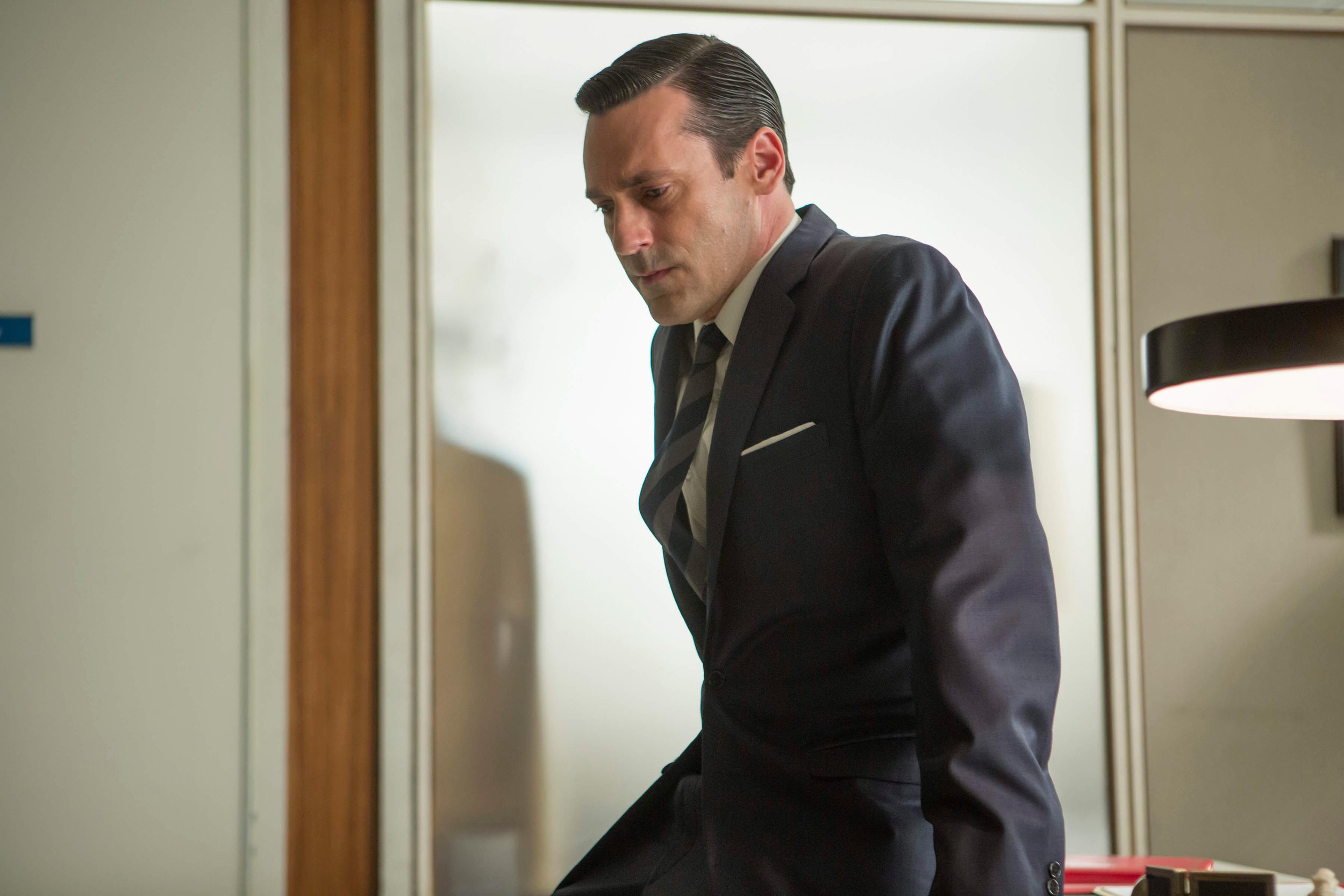
Don Draper (Jon Hamm) didn’t strike it lucky as a child. He knows it deep down. But we don’t. Not until much later, in the mostly jocular day-to-day lives of our Mad Men, brilliantly written by Matthew Weiner. No. Don Draper lives with secrets of trauma. Secrets he hides. With alcohol. Women. Sex. Success. But even a carefully constructed lie takes its toll. You can’t really blow smoke over your own eyes.
So, Mad Men begins. Season 1, episode 1: When Smoke Gets in Your Eyes. Yes, emotional distress clouds your judgment and keeps you from seeing reality clearly. Usually, Don Draper looks as cool as a cucumber. Don’s a smooth man. In control. But if we watch him closely, his hands sometimes shake. And sometimes he’s somewhere else. Not in this reality. So, what’s the smoke in Don’s eyes? It’s “smoke” from the past. Past trauma, severe childhood trauma. That kind of smoke clouds your vision. It casts a shadow. It triggers flashbacks. Like when Don sees a bug on the ceiling as he’s falling asleep. He’s somewhere else, in combat. Yes, Don served in Vietnam.
But he’s fighting another war.
Strike it lucky. Or don’t. It’s not always a winning game. Don gives it his best shot. The Lucky Strike account was a close call. He needs to feel wanted. Women want him. Usually. Midge wants him. She adores him. She’s neither controlling nor rejecting because she doesn’t want to be pinned down. Like Don. She’s a free spirit. He can have her whenever he wants, but he can’t really have her. So Midge isn’t a threat. But some women are. The ones who make him feel small. The ones who trigger the past.
Don & The Threat of Strong Women
We watch. In the meeting with Rachel Menken (Maggie Siff). A powerful woman. A woman who won’t let any man think he’s above her. Don doesn’t like that. As smooth as he is. As charming. As often as he gets any woman he wants. Don has problems with women. Especially strong women. Maybe it’s because of his stepmother. His rejecting. Cruel. Brutal. Stepmother. Who told him what he wasn’t and how wrong he was. Nothing good. That’s how Rachel makes him feel. And he can’t stand it. He falls apart. Loses his cool. Rejects her before she rejects him. But he smooths it over. Gets back on his feet. For now…
When a woman, a mother, breaks your spirit, puts you down, and makes you feel like you’re nothing more than trash, it haunts you. It stays with you and can eat you up. That’s Don Draper. No amount of success (or any new presumed identity) takes that away until you have someone or a way to help you face your trauma. That means learning that the names you were called and the way you were treated aren’t true. It was never about you.
But Don isn’t there yet, and many things trigger him. We see that right away in When Smoke Gets in Your Eyes. As Mad Men unfolds, we learn why. For now, suffice it to say that as smooth as Don is on the surface, he's vulnerable and brittle on the inside.
And that’s why any mention of Freud unsettles him, making him as defensive as can be. Freud is the master at understanding how unconscious forces drive our behavior. And Don has struggled his entire life to keep his anxieties and past as unconscious as possible. Of course, that never really works. As I said, trauma has its triggers.
Enter, Dr. Guttman...
Another strong woman, Dr. Guttman, the psychoanalyst Sterling Cooper hires, is a major threat to Don, especially when she speaks as if she knows more than he does. This is a time when men have the upper hand, and women are just on the cusp of finding their voices. And Don has a complicated relationship with women. The trauma of his past, including the loss of his mother at birth, his mother’s origins, his terrible hunger to be loved and desired, and his terrible, terrible fear that love doesn't exist, all play their part.
So, Don calls her Miss, and she corrects him, saying it’s Doctor… Dr. Guttman. Yes, he has trouble with powerful women. And it doesn’t really matter what she says. What matters is that she is trying to tell him how to do his job. No, Dr. Guttman doesn’t really know the world of advertising; Don knows more. But Don is insecure. Don’s “cool” is being upended.
And now, he disputes all of psychology, saying it might be great at cocktail parties, but “people were buying cigarettes before Freud was born” (yes, Freud himself had mouth cancer long before the research even came out...). But really, it’s Dr. Guttman’s suggestion of a death drive that gets to Don. He throws her research in the trash, ends the meeting, and walks out, saying he finds her whole approach “perverse.”
The Death Drive. Yes, that scares him.
Freud’s Death Drive & Don’s Trauma
Talking about death can be scary. Saying there’s an unconscious drive toward death can certainly scare anyone, especially someone like Don. What is Freud’s Death Drive?
Here’s how I understand it in relation to trauma reactions. Yes, the death instinct is controversial, but it has a place in understanding trauma reactions, especially numbness, dissociation, and “forgetting.” Freud developed the concept to explain how trauma victims or war veterans repeatedly re-experience painful, distressing events. The pain of these repetitions, or “remembrances,” is unbearable. A traumatized child, later an adult, needs to keep things safe. There can be no change. No dangerous connections. So, as “Eros” (the life drive) seeks to create bonds, the death drive pushes to break them.
Don knows this well, not consciously, of course. But the idea of keeping things dead stirs a reaction. He killed his old identity, Dick Whitman. He didn’t want to be Dick, with all the shame. Being Dick was pure shame, and he had to get rid of him. Kill him. And become Don Draper, a man he could respect. A man the world could respect. Because all traumatized children carry the past with them and feel that everyone sees them that way …
The Lucky Strike Problem
The whole Lucky Strike thing? It’s a perfect storm. Everyone knows cigarettes kill, but people “love to smoke,” so no one wants to believe it. Just as no hurt, rejected, hungry, lonely child wants to live knowing pain. Don’s a Lucky Strike man. No, he didn’t strike it lucky at the beginning, but he manufactured his luck. It’s the advertising thing. You lie to make a living. And he’s terrified that his luck could change at any time, that he’ll be uncovered, stripped bare, and have everything taken away once again. The mother he lost. The mother he never knew. The mother who lived in shame, too. Lucky Strike. Lying about how they won’t kill you? Don knows better. His childhood “killed him,” and he had to kill it. He sits with his hand shaking. That’s a trauma response. He’s triggered. Don lives a lie. He does have a death wish. That’s why he hated Dr. Guttman. She exposed a truth. Salvatore (Bryan Batt) said it straight: “So we’re supposed to believe people live one way and secretly think the opposite? That’s ridiculous.”
Well, Salvatore (and Don), you know it’s not.
You can’t advertise death. Don knows that. He can’t expose what he’s really done. But what he tells the Lucky Strike owners is what he wants for himself. He wants to cover up the truth, the hard, cold, death truth. “Lucky Strike isn’t about death.” “It’s toasted. Everybody else’s tobacco is poisonous.” That’s Don’s brilliance. He knows what people want. He knows what clients want. He knows what he wants. “Advertising is based on one thing: happiness. Happiness is the smell of a new car. It’s freedom from fear. It’s a billboard on the side of the road that screams reassurance… That whatever you’re doing, it’s OK. You are OK.” That’s Don. He needs to believe whatever he’s done is OK.
Why Don Needs the “Happiness” Pitch
It’s freedom from fear. It’s a billboard on the side of the road that screams reassurance. Whatever you’re doing, it’s OK. You are OK…” This is what Don lives with, and this is what he has to keep telling himself: “You are OK, you are OK. You are OK. Everything you are doing is OK. Whatever you are doing is OK.” Because deep down, he doesn’t believe it; he doesn’t believe in himself, and he knows what he’s done isn't OK… But he did it because he feels that the very essence of who he was, in all his shame, isn’t OK at all. He believes he’s not good. That's the beginning of understanding Don Draper’s deepest fear and deepest pain. Everything he tries to reassure himself against, but ultimately can’t. Roger saw Don freeze. He saw Don’s hands shake: “You had me worried. That was inspired.” Don wants to believe, “I pulled it out of thin air.”
But he didn’t.
Don pulled it straight from his unconscious. As much as he wanted to defeat the psychoanalyst, Dr. Guttman, who tried to tell him about Freud and his theories, Don is living proof that the unconscious can drive everything inside us. What especially drives us are the things we try to run from as fast as we can and hide from ourselves, as if they don’t exist. But they do. And they come back, for better or worse. Sometimes for the worse. This time for the better, saving Don’s skin. But it only puts his ability to keep lying to himself back together, over and over and over. At least, for now.
Roger asks, “After what you pulled up today, can you patch things up with Rachel Menkin? She’s worth $3 million.” Don says, “You’re a whore.” He knows about that…
Don Doesn’t Believe in Love...
Don didn’t grow up with love. Far from it. He didn’t grow up with acceptance. He doesn’t accept himself. He can’t accept people who are “different.” That’s the nature of antisemitism and racism. It’s at the heart of trauma. A traumatized child feels different. On the outside. Unlovable. Bad. Trusting no one. Don knows about seduction. He knows how to make himself desired and to get what he wants. But he doesn’t trust love. When Rachel Menkin says she’s never been in love and that’s why she’s never gotten married, he says: “You’ve never been in love because love doesn’t exist. It’s invented by people like me to sell nylons.” Don is cynical about love. He has every reason not to believe in it.
Rachel asks him, “You really believe that?” “I’m pretty sure of it. You’re born alone, and you die alone in this world that just drops a bunch of rules on you.” Really, Don was born into a world that dropped “a bunch of trauma on him.” And there was no love there. Rachel understands, though. She knows more than Don thinks. “I didn’t realize until this moment that it must be hard to be a man, too.” He says, “Excuse me?” “I don’t know what it’s like to be a man, but I do know what it’s like to be disconnected and out of place…”
Rachel Menkin gets Don’s hurt. No one else ever has. She gets what it’s like to build a hard shell. What it’s like to carry on as if nothing touches you, even though it does.