
HAMNET: What Stops You From “Living with Your Heart Open”
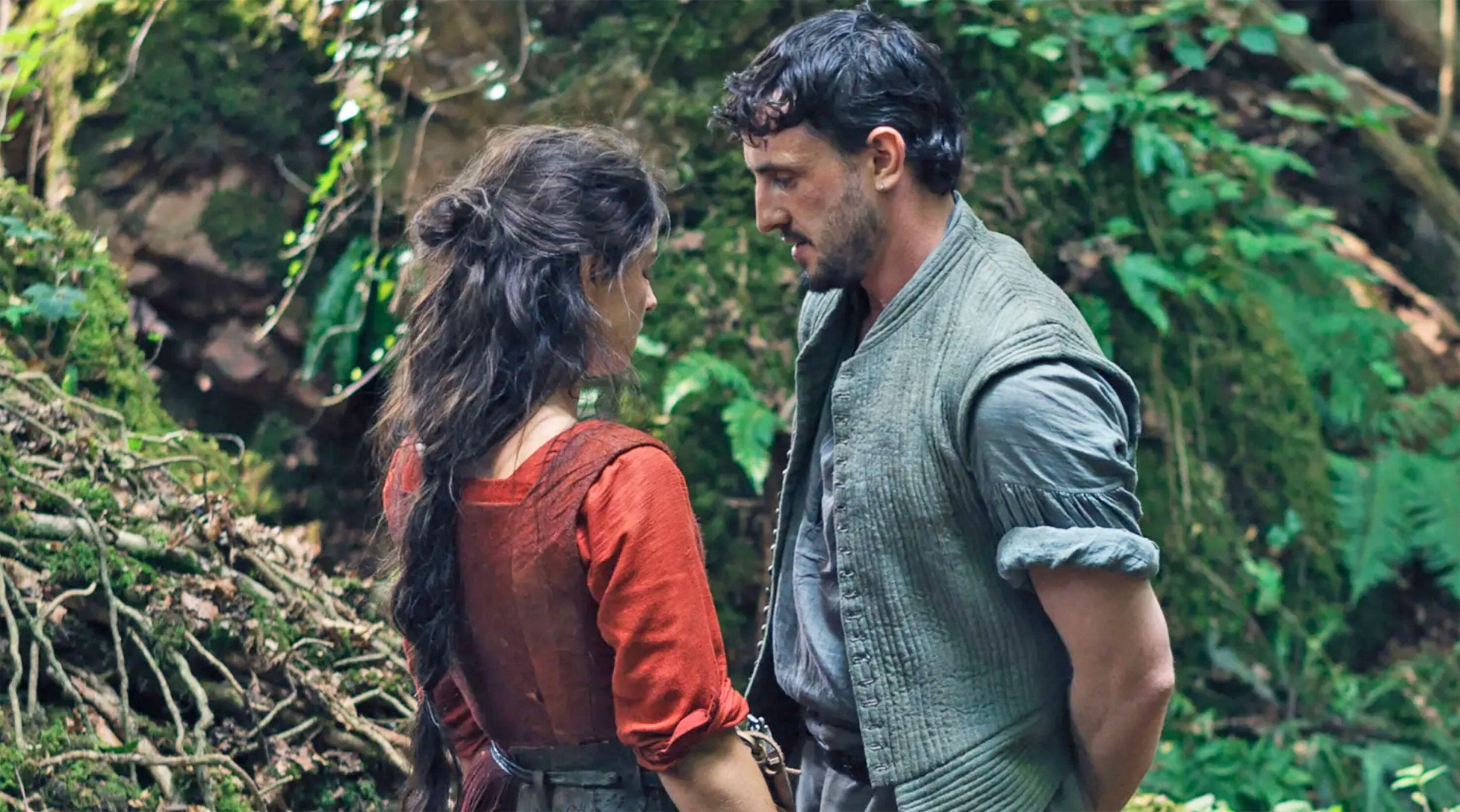
Agnes and Will didn’t have easy childhoods in Chloé Zhao’s Hamnet. Perhaps Agnes’ life was harder. She lost her beloved and loving mom early in her life, “replaced” by a cruel stepmother who rejected and taunted her for being “the child of a forest witch.” If not for the hawk, the forest, what her mom taught her, and her biological brother, Bartholomew, she might have shut down to living in the real world and to Will’s love, completely. Bartholomew reminds her of their mother’s wisdom: “To live with our hearts open. To shut it not in the dark.” Yet, fear, more loss, “betrayal,” misunderstandings, can close up your heart, just when you need love the most …
That’s what happens to Agnes and Will. Will suffered cruelty and misunderstanding, too. A sensitive soul with an abusive father. He and his father fight. His father demeans him for his fancy airs, “all that education and no common sense.” He knocks Will on the head because the father says that the boys he’s tutoring at Agnes’s farm are not scholars. Will fights back: “I’m tutoring them to pay off your debts to the family, am I not?” He is. He’s hurt and misunderstood.
Will is taken by Agnes. The two are the same. He watches her, thinks she’s a servant, the way she carries herself, wary with shame, fear, suspicion. He kisses her, and she runs away. They do find each other. But it’s impossible not to take in and believe the cruelty. Is love dangerous, then?
Is Falling in Love Dangerous?
When you’ve been hurt by love, when you’ve lost your mom and received cruel treatment after, needing love (wanting love) can feel terribly dangerous. What if it happens again? You expect that. You tell yourself, “Don’t open your heart. Play it safe. The hawk is your friend. Not people.”
That’s Agnes (Jessie Buckley). She does what’s expected. Resents her stepmother’s in-her-face-favoritism of Agnes’ step-sisters. She keeps her head low. Spends as much time in the forest as she can, with her hawk. She trusts the hawk. Her family? No. Just her full-brother, Bartholomew.
When the stepmother asks if Agnes has met the tutor, demeaning him, “Like father, like son…” Agnes denies it. But she’s quite taken with Will. He meets her with her hawk, and the hawk likes him. She sees his tenderness. The hawk knows. So. Maybe he’s different? Maybe Will is safe?
Will’s (Paul Mescal) parents challenge him, too. His mother says, “They say the eldest daughter (Agnes) is the child of a forest witch.” Eliza, his sister, says that she walks into the forest and is accompanied by a hawk on her arm. Will denies having seen or met her. But he’s confused. He asks his sister, "Are you certain, Eliza? The eldest daughter keeps a hawk? Not a servant girl?"
He goes looking for Agnes and brings a new glove for her hawk. She rejects it and him. Testy. Cold. Yes, Agnes’ walls are up. How can she trust him—or anyone? Will tosses the glove away. But he doesn’t give up. (He doesn’t know the glove she can’t lose was her mother’s. Precious. Irreplaceable. But maybe he would understand?) He says he knows who she is. She quips, “The child of a forest witch? I’ve learned many things from my mother.” Will is tongue-tied. She teases, “I thought you were a man of words.” “Sometimes talking to people is hard for me.” “Tell me a story then.” “A story?” “Yes.” He tells a story of love lost. The story she’s afraid will happen again.
The Forest & Hawk Are “Safety”
Will circles her, like her hawk circles the sky, out of breath. “I must be handfasted to you. I will be handfasted to you. I will speak to your stepmother and brother. They won’t agree. But no one else will do. I can’t abide waiting.” He kisses her passionately. “Follow me.” They make love. Chase each other, happy, playful, through the forest. He carries her on his back. “My glove. This is my mother’s glove. The women in my family see things that others don’t…”
Soon she is with child. They marry. Will is safe. Sort of. But her real safety is in the forest. Where her mother’s spirit lives. Where her hawk comes to visit. Watches her. With him, she isn’t alone. But, as Will’s mother, Mary (who lost many children), says: “What is given will be taken away.”
That is always Agnes’ fear. The Forest. Where she lost her mother, where her mother’s spirit never leaves her, is the only place where she can breathe. Her hawk circles. He knows. So, when Agnes goes into labor, she disappears into the woods, giving birth alone, panicking Will. Bartholomew knows his sister. He takes Will to find her there, with their baby. A girl. Susanna.
They’re happy for a time. But, Will? He’s lost, frustrated with his writing. Self-hating. Just like his father hates him. Agnes walks with her brother to talk to Will’s father. “He’ll listen to you. He (Will) needs to go to London. He needs distance from his father. If he doesn’t go, I will lose him.”
The hawk dies, her protector. She’s let down her guard. She can’t bear another loss.
She can’t.
Being Brave When You’re Not
There are many ways to be brave when you’re not. You toughen up. Like Agnes. You hide your softness under layers of hard-earned fear. Forge ahead into love against your better instincts. Because love takes all the courage you don’t have. Siphons any last drop of self-protection out of you until you’re gasping for air, trying to get back up to the surface. That’s Agnes. Yes, she’s a fighter. Yes, she’ll do anything for her children. For Will. Until she can’t. Then, there’s Hamnet.
Like mother. Like son. Hamnet loves deeply. That makes him vulnerable. His heart has always been open. But he needs his dad. And his dad is always leaving. Is Will brave? Maybe not. Since he leaves at the very times he’s needed. Hamnet tries not to cry. Hamnet, too, is afraid of loss.
He asks Will if they will go with him. And when he’s told, “No, not this time,” Hamnet says ok even though it’s not. And when his father asks him to be brave. To take care of his mother and sisters, he says, “Yes.” And, he won’t break his promise. He won’t let anyone see he is scared.
His mother is scared too, but the always-brave Agnes asks to see Hamnet’s hand. She tells him she sees him growing up and in the theater with his father. They’ll be together. Not to worry. She says he will be one of the players having a sword fight. And, of course, he will win.
“I’ll be brave, father, I’ll be brave.” Yes, brave. Agnes, too. Until she can’t.
“I’ll be brave, Father.
Terror of Loss & Losing Hamnet
“Yes. Go, please go,” she tells Will earlier, before Hamnet is born, knowing he must. It’s hard for them to be apart. She’s pregnant again. And, Will isn’t there for the birth. His parents won’t let her go to the forest. The river has burst its banks. She’s writhing in pain, screaming, “I can’t. I will not have my baby in this house.” Agnes is frantic. Hamnet has been born, but now a second baby is coming, a girl, whom they first think is stillborn and are going to take away. Agnes sees “two children at my deathbed.” She’s panicked. Demands to hold her baby, having a flashback to her mother’s death, when they stopped her from seeing her mother. She was screaming then. She’s screaming now. She will see her daughter. No one will stop her. She tells her baby, Judith, that she will live, “I will make sure nothing ever takes you away.” How can she stand more grief? She’s terrified of losing Will. That’s why she wouldn’t let herself fall in love with him at first. Now more?
Judith doesn’t die. Agnes keeps a close watch on her. Terrified. Of seeing only two at her deathbed. She never in a million years imagines her robust (but sensitive) Hamnet will be the one taken. He watches over his beloved twin when she gets the pestilence. Agnes frantically gives her herbs and potions to save her as Hamnet looks on. Now Agnes is away. Judith isn’t waking up.
Hamnet will be brave. Like his father told him. His heart can’t bear the loss either. They’ve always been together. Judith says, “Don’t be sad. You shall be well.” Hamnet says, “I shall not live without you.” He’s crying. “Do you see it, Jude? I’ll tell it to take us both. We’ll go together. Turn away, turn away, it’ll make a mistake. It can’t tell us apart. Breathe with me, Judith. I give you my life, Judith. You will be well. I’ll be brave.” I’ll be brave, Father. I’ll be brave. Brave. I’ll be brave.
Agnes finds him with Judith. “Hamnet, you’re not supposed to be down here. Hamnet!!!” She struggles to save him. “Hamnet, don’t be scared. Mommy’s here. I will never let you go. I love you. Hamnet. You have to stay. Mommy needs you. We need you. You have to stay.”
Will rushes home. “Am I too late? He thought Judith had died.
He doesn’t know it’s Hamnet.
Why Grieving Hearts Might Close
Will’s love made Agnes brave. Brave enough to love. Brave enough to risk loss. Until loss hits again. Twice. Hamnet. And it seems Will is gone. Agnes doesn’t know it’s just that his tender, broken heart has closed up, too. To manage the loss of Hamnet. To manage his guilt at not being there with his boy. His family. With her. Agnes tries not to blame herself. But she does. “I didn’t see it. I should’ve paid him more attention. I always thought she was the one to be taken away, while all the while it was him. I’m a fool.” Angry at Will, when he tries to reassure her: “You weren’t here, you weren’t here ... He died in agony, and he cried, and he cried. He was so scared, and you weren’t here.” For a moment, it softens between them. But. He’s leaving again. So quickly. How can he leave when she’s so scared? She hits him. They struggle. He tries to hold her. She pushes him away, “Go, go.” It’s the nail that closes her heart. Will’s heart is closing too:
“Everywhere I go, I’m wondering where he is. I have to find him ... I fear I might run mad with it even a year on.” Agnes says, “A year is nothing. Nothing. It’s every second, every minute, every day. We may never stop looking for him.” I’m sorry, Agnes.” “For what? You’re caught in that place in your head. It’s more real to you than anywhere else. Not even the death of our child can keep you from it. Hamnet died a horrible death, and you should’ve been there. You could have bid him farewell ... You should go back to London ... We get along just fine without you.”
She closes her heart. This is the Agnes he first met. Walled off. Defending against more loss by creating it for herself. By closing down. Pushing him away. Because she thinks he doesn’t care. But. Will grieves in his own way. Filled with self-hate. Self-blame. Guilt. Close to suicidal. Sobbing:
To be or not to be—that is the question:
Whether ’tis nobler in the mind to suffer
The slings and arrows of outrageous fortune,
Or to take arms against a sea of troubles
And, by opposing, end them. To die, to sleep—
No more—and by a sleep to say we end
The heartache and the thousand natural shocks
That flesh is heir to—’tis a consummation
Devoutly to be wished. To die, to sleep—
To sleep, perchance to dream
Will lost his way. But he writes his way back to Hamnet.
By writing Hamlet, he remembers.
Hamnet, dying, wanders lost, scared, crying out, “Mama, mama.” He rubs his hands together, blows into them, making a wish, whistling. He sees the hawk. Crying softly,
Hamnet’s looking up.
Remembering Lost Ones Back to “Life”
Grief never goes away. It lessens when you don’t have to die along with the one you love, when you don’t close your heart. Out of despair. Guilt. Fear of losing again. Hamnet isn’t lost. Not to, happy remembering. Not if they can hold him, in their hearts, close inside. Can both Agnes and Will open their hearts again? Mostly to each other?
Can they remember the hawk?
“Blow a little wish. To wish him on his way. That’s your secret with him. Did you see him? Did you not see him in the sky? Do it again, make another wish. Did you see him? He’s got all your wishes tucked in his heart. And anytime you want to remember him .... all you have to do is whistle.”
All you have to do is go to London and see Will’s play. To wonder what he wrote. To see Will playing the ghost of the King. To know that he is bidding Hamnet farewell, in his own way. And. There is her son. On stage. Blonde. Yes. He looks like Hamnet. Will, the ghost, says, “I am my father’s spirit. Doomed for a certain term to walk the night ...Oh, Horrible, most Horrible ...” As Will turns away, Agnes, watching, pleads, leaning against the stage, “Look at me. Please look at me.” He turns slowly, painfully, and sees her. Their eyes meet. He takes Hamlet’s face in his hands and says, “My boy. Adieu. Adieu, adieu.” Will cries softly. Agnes has tears in her eyes, too. The ghost kisses Hamlet on the cheek: “Remember me.” The remembering of Agnes’ hawk.
Off stage, Will continues to sob, consumed by his grief. On stage, Hamlet says, “To be or not to be. To die. To sleep. Per chance to dream. Ay, there’s the rub.” Will, perhaps, has chosen to be.
Agnes sees her son on his father’s stage doing the sword fight he wanted to do, but he doesn’t win. He dies. But. She now reaches out her hand to the dying Hamlet. The whole audience reaches out their hands towards him. The rest is silence. That’s his last line. But is there silence?
Maybe not. Agnes isn’t alone in her grief. Maybe she never was. She sees Will. He sees her. Might they open their hearts again, now that Agnes has seen Hamnet? There in spirit. Hamlet turns. Nods. Smiles. She smiles back and puts her hand over her heart. Watches Hamnet go through the portal door in peace. Knowing his family is OK. The brave boy. Agnes laughs softly. Will’s help remembering means Hamnet does take care of his family. He brings them together again.